
How to Build Passive Income With Real Estate
Most passive income from real estate still takes work. Learn how much each route asks of you, what you give up in return, and how to check a fund's numbers.
Almost everything sold as passive real estate income involves work. What changes from one route to the next is how much. At one end you run a short-term rental yourself. At the other you hold a fund that invests in other funds. Before picking a route, work out how much of your time it will take and what you give up to get that time back.
This guide to building passive income with real estate ranks the common routes by how much work they take in practice. It then covers two things most guides leave out: what the money looks like when it lands, and how to read a fund's reported numbers before you rely on them.
The passivity ladder
Is real estate passive income? Some of it comes close. Most routes take more of your time than the label suggests. The routes below run from most work to least. Their returns are not ranked, because returns do not sort neatly in either direction.
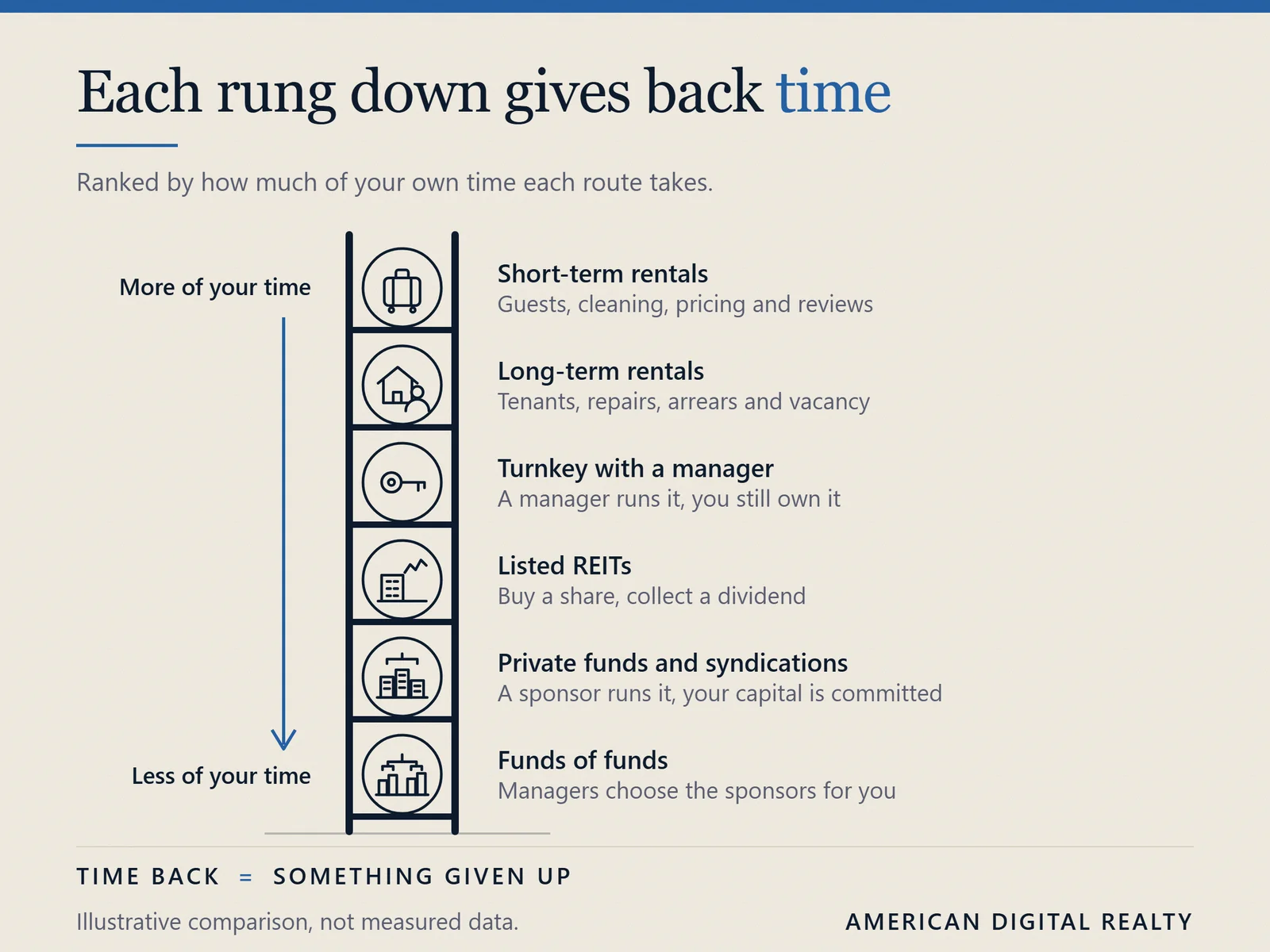
Short-term rentals. This takes the most time of any route. Guests turn over every few days, and the cleaning, pricing, reviews and platform rules add up to an operating business with a property attached.
Long-term rentals, managed yourself. Much less work than short-term rentals, but still a business. You underwrite the purchase, arrange finance, screen tenants, handle maintenance, chase arrears and carry the vacancy when the unit sits empty. Calling it passive is like calling a second job passive because you set your own hours. The income can be excellent, but you will be involved, and one bad tenant or a failed roof can absorb a year of it.
Turnkey rentals with a property manager. With a manager in place, this is less work than running a short-term or long-term rental yourself. You still own the asset, so the capital decisions, the large repairs, the vacancy risk and the eventual sale are still yours. The manager takes on the daily calls and the maintenance, and the ownership decisions stay with you.
Publicly listed REITs. These are passive in the full sense. You buy a share, income arrives as a dividend, and you can sell on any day the market is open. What you have bought, though, is a listed equity, and it behaves like one. The section on REITs further down covers what that means for your returns.
Private real estate funds and syndications. Day to day, there is little for you to do. Someone else sources the deals, underwrites them, arranges the finance and runs the properties. In exchange you give up liquidity and control. Your capital is committed for a defined period, and changing your mind is not grounds for getting it back.
Funds of funds. This is the furthest you can sit from the buildings. Instead of choosing one sponsor or one property, you hold a portfolio of underlying funds, which means hiring a second layer of selection and paying for it. In return you get diversification across sponsors, sectors and geographies from a single position, and that is very hard to assemble yourself at a sensible cost.
What passive income costs you
Each step down the ladder gives you back time, and each one takes something in exchange. What it takes is usually one of three things.
Control. You cannot tell a fund manager to sell a building, refinance it or change the tenant mix. If you have strong views about a particular market, handing those decisions to someone else is a real cost.
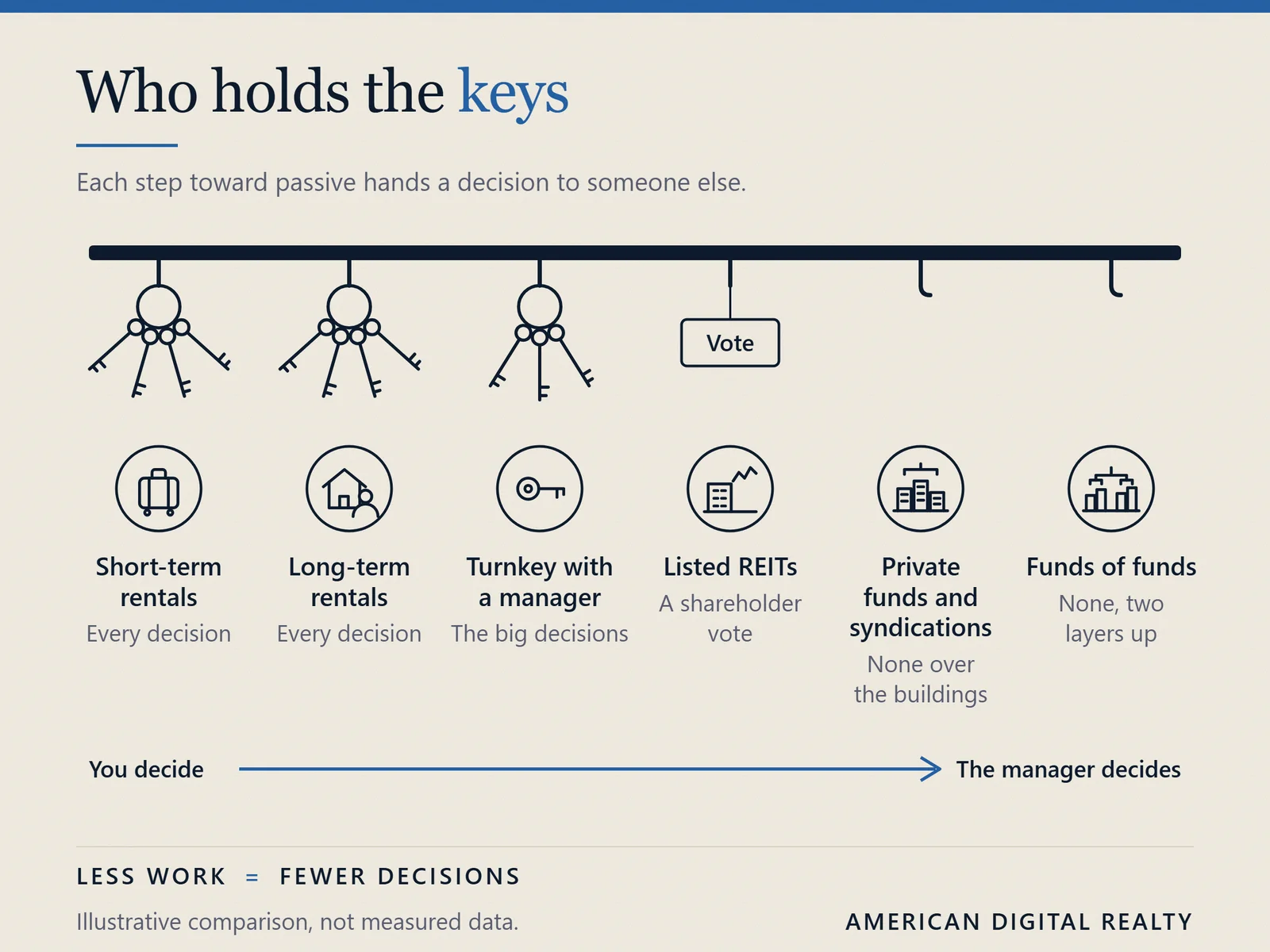
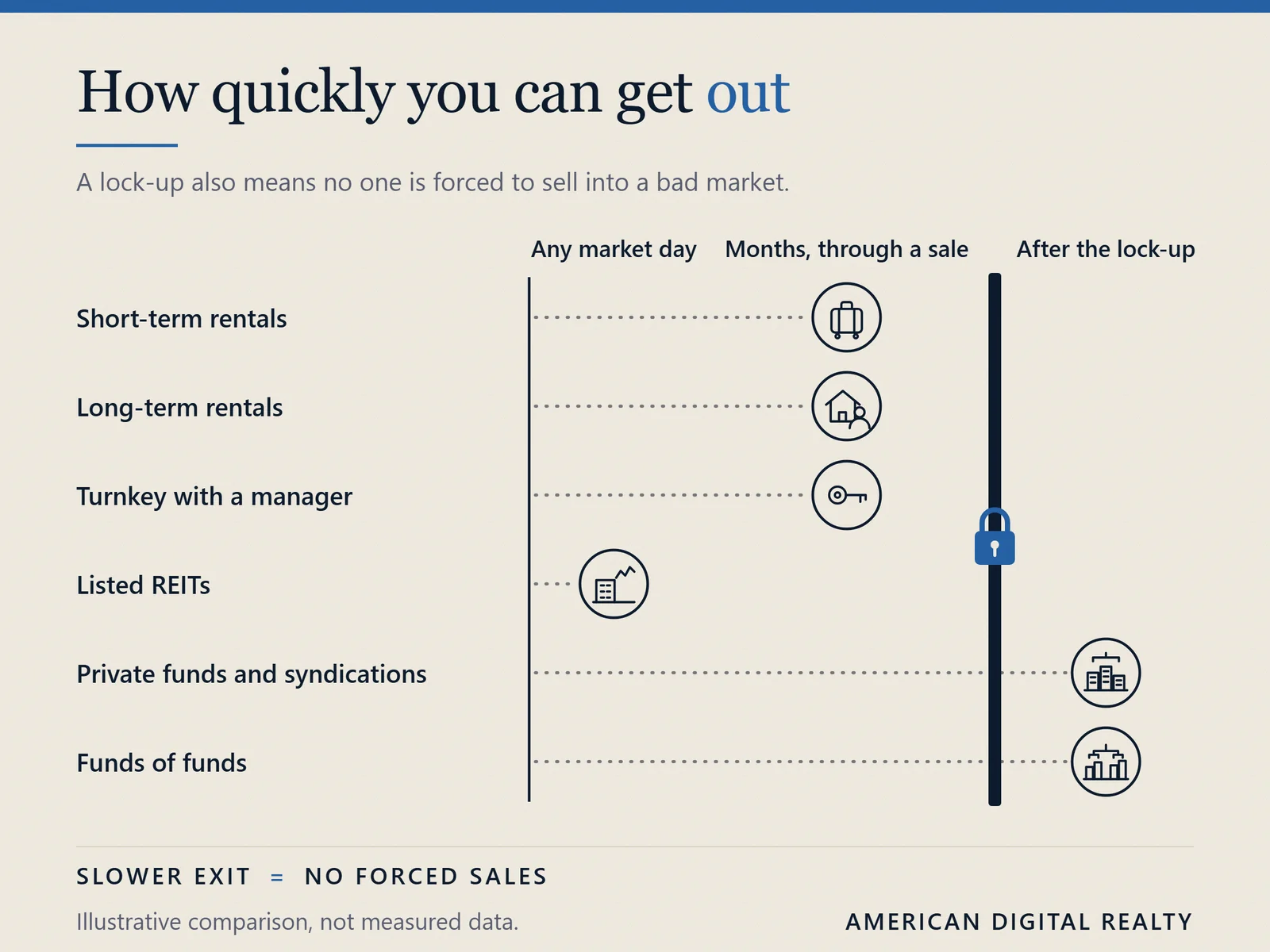
Liquidity. You can sell a listed REIT on any market day. A private fund typically holds your capital for a defined lock-up period, and after that any transfer is subject to conditions. Some of the return comes from this constraint, because a manager who is not meeting redemptions is never forced to sell into a bad market.
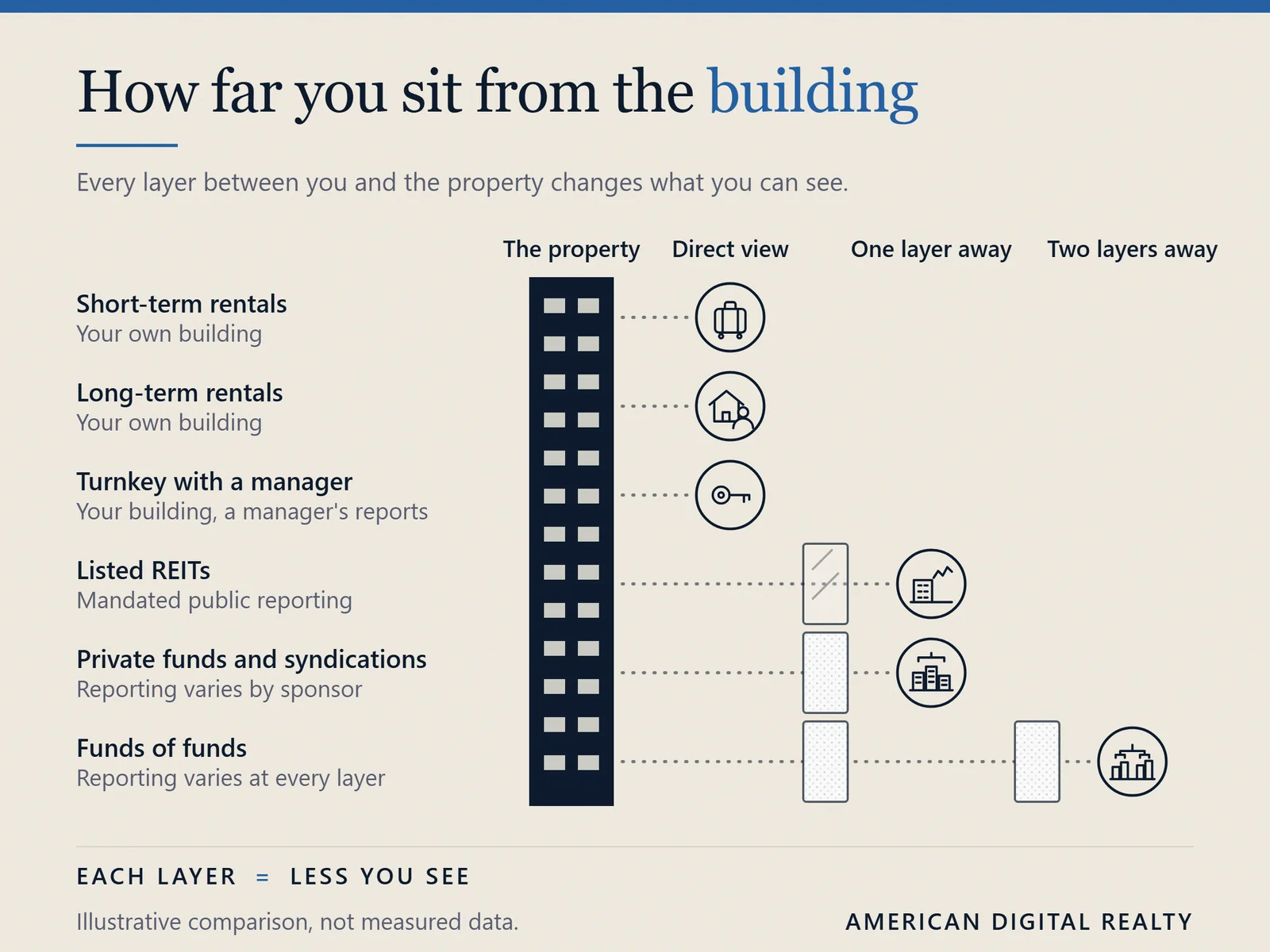
Transparency. This one gets the least attention. If you own a building, you know exactly what you own. If you own a fund of funds, you may be several layers away from any actual property, and the way that gets reported to you varies enormously between managers.
What the income looks like when it arrives
Most guides stop at "you receive distributions". Four details decide whether that income fits your plans.
It usually arrives quarterly. Private real estate income generally follows a quarterly cycle, because the underlying rent, debt service and fund accounting settle on that rhythm. If your budget depends on a monthly check, a private fund is the wrong instrument.
It may not start straight away. Newly called capital has to be deployed before it earns anything, so distributions commonly build up over the first year. A sponsor who promises income from day one is making a claim you should check.
The tax paperwork comes late. US private funds report on a Schedule K-1 rather than a 1099, and K-1s routinely arrive later in the filing season than your other tax documents. Plan for a filing extension from the start so it does not catch you out.
Reinvesting is your call. Some structures pay income in cash and some let you reinvest it into more units. Reinvesting compounds your returns, and it also enlarges a position you cannot exit quickly. Make that election deliberately instead of leaving whatever the subscription form defaulted to.
Listed REITs and private real estate behave differently
People often treat the two as interchangeable ways to own property, and they are not.
Picture a building you own outright, rented to a tenant on a five-year lease. Now picture a crowd bidding on that building every few seconds while the market is open, pricing it on interest rates, earnings season and how the stock market feels that morning. The rent does not change. The value on your statement changes constantly.
That is a listed REIT: a stock that owns buildings, priced every day by the stock market rather than by the rent its buildings collect.
The data shows the gap over the ten years to 2025.
| Private commercial real estate (NCREIF) | Public REITs (NAREIT) | |
|---|---|---|
| Annualized return | 11.5% | 6.4% |
| Annual volatility | 8.1% | 18.6% |
| Maximum drawdown | 14.8% | 41.9% |
Both sets of figures describe the same asset class. One is priced off leases and the other off market sentiment, and the table is what that difference looks like over a decade.
That difference is also why holding a REIT ETF does not give you private real estate exposure, and why adding private exposure diversifies a portfolio that already holds REITs.
REITs do have real advantages: daily liquidity and a low minimum, neither of which a private fund offers. If you need to be able to sell next Tuesday, the higher volatility is the cost.
How to read a fund's numbers before you trust the income
Four questions will tell you most of what a headline figure leaves out.
Return
Ask what a return is made of. A reported monthly figure can be recurring income, an unrealized revaluation of the underlying assets, or a one-off adjustment. Only the first of those recurs, so it matters which one you are looking at.
A single revaluation can make one month several times larger than the months around it, and carry a half-year or annual figure well above anything the income alone would produce. The headline is still accurate, because it is what the fund returned. It answers a different question from the one an income investor is asking, which is how much cash the assets produce and how steadily they produce it.
So when any manager shows you a return, ask how much of it was cash the assets generated and how much was a change in the value they are marked at. Ask to see the individual months as well as the total. If a manager cannot separate income from revaluation, or will not show you the months, you are being asked to take the headline on trust.
Holdings
Ask what the fund holds. A fund of funds that reports only one level deep tells you it owns other funds, which says nothing about your real exposure. Proper reporting looks through each position to the assets underneath. American Digital Realty reports the ADR US Diversified TREIF that way, and at June 30, 2026 the split was multifamily 24.6%, senior debt 24.5%, mezzanine debt 20.4%, manufactured housing 15.0%, industrial 10.6% and self storage 4.8%. So 55.1% of the portfolio is property ownership and the rest is credit strategies, which is a very different risk profile from what "a real estate fund" suggests. No label would tell you that, and any manager should be able to give you the same breakdown.
Fees
Ask for the total cost, not just the management fee. The management fee is a single line. A fund also pays its own operating expenses, and many funds amortize their formation and startup costs over their first years. These costs are legitimate and disclosed in the offering documents, but they sit outside the headline fee, so a fund charging no management fee during its launch period still costs you something. Ask for the total expected expense load, and ask where it is written down.
Liquidity
Ask, in writing, what happens when you want out. "Is it liquid?" tends to get a comfortable answer, so ask for specifics instead. How long is the lock-up? What is the process once it ends? Who sets the price? Is anyone obliged to buy? A vague answer to any of these should worry you.
How to invest in real estate for passive income
If you are investing in real estate for passive income, the right route depends less on ambition than on how much capital you have and whether you are eligible.
If you are starting with a few thousand dollars and want real estate exposure now, a listed REIT index fund is the sensible choice. It is passive, the minimum is trivial and you can sell whenever you like. It will not give you the highest returns, and it will move with the stock market, but it does not pretend to be anything else.
If you want direct control and accept that it will be a job, buy a property, and budget your time the way you would for a job.
If you have meaningful capital, want private market exposure and can accept that the money is committed, private funds are built for exactly that. Diversification across sponsors and sectors matters more here than in most asset classes, because sponsors do fail. That is the case for a diversified structure over a single deal.
American Digital Realty builds diversified commercial real estate funds for investors who want the income without the operating work. Diversification engineered for consistency.
This article is general information about how real estate income structures work. It is not investment, legal or tax advice, and it is not an offer to sell or a solicitation of an offer to buy any security. It does not take account of your circumstances, and the right route for you may well be one of the options above that is not ours. Any American Digital Realty offering is made only through official offering documents, pursuant to Rule 506(c) of Regulation D, to investors whose accredited status has been verified. Fund figures shown are historical. Past performance is not indicative of future results.