
Why Consider Commercial Real Estate Investing?
Benefits of investing in private commercial real estate.
Key Benefits
Strong Return Potential
Private commercial real estate has historically delivered compelling long-term total returns and favorable risk-adjusted performance compared to equities and bonds.
Consistent Income Generation
Over the past 20 years, private commercial real estate has provided higher average income returns than both US bonds and equities.
Additional Advantages
Investing in private real estate can offer diversification, act as a hedge against inflation, and provide potential tax benefits.
Understanding Private Commercial Real Estate
Private commercial real estate refers to properties that are not publicly traded on stock exchanges but are owned by individuals, investment firms, or partnerships. These assets generate income primarily through leasing space to tenants and include several key sectors:
- Multifamily and Apartment Buildings: residential complexes with multiple rental units, offering steady occupancy and rental income.
- Industrial Properties: warehouses, distribution centers, and manufacturing facilities, benefiting from the rise of e-commerce and global supply chains.
- Self-Storage Facilities: secure storage units for personal and business use, providing high occupancy rates and low operating costs.
- Data Centers: facilities housing critical IT infrastructure, benefiting from the growing demand for cloud computing and digital services.
- Office Buildings: corporate and professional spaces leased to businesses, providing stable tenancy and long-term rental agreements.
- Retail and Specialty Properties: shopping centers, medical offices, hotels, and niche assets catering to specific markets.
How Commercial Real Estate Creates Long-Term Financial Security
Investing in commercial real estate is a time-tested strategy for building long-term wealth. These properties provide investors with dual benefits: steady rental income and value appreciation over time. Unlike stocks and public REITs that can be influenced by daily market swings, private commercial real estate offers stability and tangible ownership. Savvy investors use this asset class to create lasting financial security and wealth accumulation.
Comparing Asset Classes
Commercial real estate has consistently delivered high returns, low volatility, steady income, inflation protection, portfolio diversification, and tax advantages relative to bonds, stocks and REITs.
| Category | Bonds | Stocks | REITs | Commercial Real Estate |
|---|---|---|---|---|
| Average annual return | 3.0% | 10.3% | 7.9% | 10.8% |
| Low volatility | Yes | No | No | Yes |
| Cash distribution | Yes | No | Yes | Yes |
| Inflation resistant | No | Yes | Yes | Yes |
| Low correlation to stocks | No | No | No | Yes |
| Tax advantages | No | No | Yes | Yes |
Sources: Bloomberg US Aggregate Bond Index, S&P 500 Index, FTSE NAREIT Index, NCREIF Index (levered). Twenty years of historical data.
Less Volatility, More Predictability
Public markets can be unpredictable, with price swings driven by economic news and investor sentiment. In contrast, commercial real estate moves at a steadier pace, offering a layer of security for investors who prefer a long-term approach. With properties secured by tenants through multi-year leases, investors can enjoy a more predictable return profile.
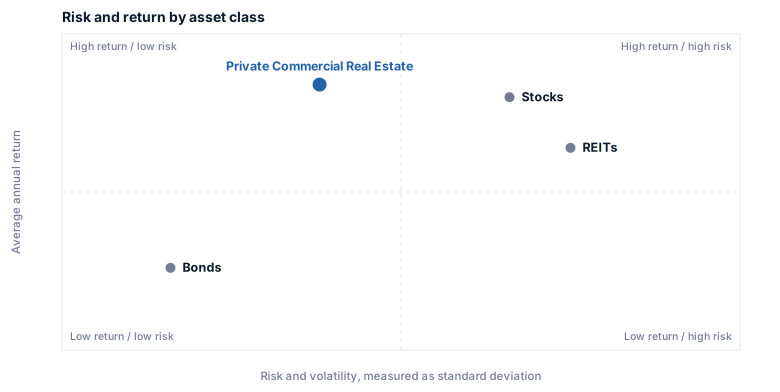
Over the past 20 years, private commercial real estate has delivered a higher risk-adjusted return than stocks, bonds and publicly traded REITs. This is because its historical total returns are more comparable to equities, while its return fluctuations over time (measured by standard deviation) have been closer to those of bonds.
Strengthening a Portfolio with Real Estate
A well-rounded portfolio benefits from assets that respond differently to economic cycles. Commercial real estate exhibits low correlation with stocks (0.06), bonds (-0.19), and REITs (0.20), meaning its value tends to move independently of these assets, which helps investors reduce overall portfolio risk, smooth out returns, and protect against market downturns.
| Asset correlation matrix | Stocks | Bonds | REITs | CRE |
|---|---|---|---|---|
| Stocks | 1.00 | |||
| Bonds | 0.06 | 1.00 | ||
| REITs | 0.76 | 0.23 | 1.00 | |
| CRE | 0.06 | -0.19 | 0.20 | 1.00 |
A Natural Inflation Hedge
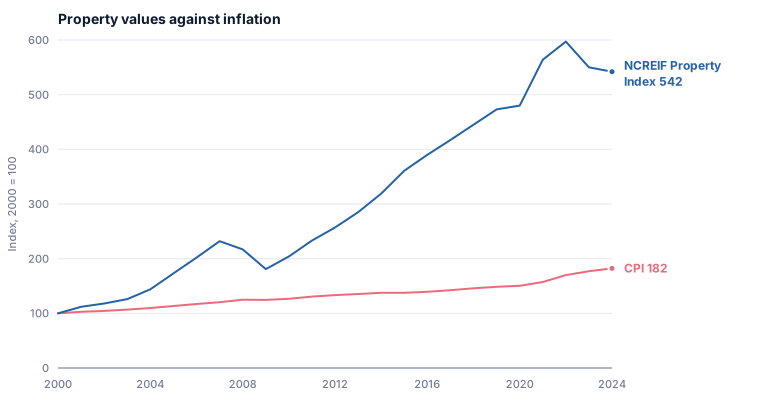
Real estate tends to perform well during inflationary periods because property values and rental income often rise alongside the cost of living. This makes commercial properties an attractive option for investors looking to preserve purchasing power.
A Dependable Income Stream
One of the biggest appeals of commercial real estate is its ability to generate income. Tenants, ranging from retail businesses to corporations, typically sign long-term leases, providing investors with a consistent revenue stream.
Tax Benefits That Add Value
Investing in private commercial real estate can offer unique tax advantages that enhance overall returns. Depreciation deductions allow investors to reduce taxable income, while long-term capital gains on property sales are often taxed at lower rates than regular income, making real estate an efficient investment from a tax perspective. As an illustration, a bond investor would need a pre-tax yield of 9.35% to achieve the same after-tax return as an 8% yielding commercial real estate investment.*
| Investment | Amount | Yield / coupon | Pre-tax income | Depreciation deduction | Taxable income | After-tax income | After-tax yield |
|---|---|---|---|---|---|---|---|
| Commercial real estate | $100,000 | 8% | $8,000 | $2,500 | $5,500 | $6,075 | 6.08% |
| Bond | $100,000 | 8% | $8,000 | None | $8,000 | $5,200 | 5.20% |
* This does not constitute tax advice. Because each investor's tax position is different, the benefits listed above may not be realized. A change in US tax laws could also have an impact on the benefits of investing in real estate. Assumes a 35% tax rate, not including state tax, and a $2,500 deduction for illustrative purposes only. Actual figures may vary.
The Takeaway
Commercial real estate offers a compelling mix of income, appreciation, and risk management, making it a valuable addition to a well-balanced investment strategy. By providing stable returns, inflation protection, and tax advantages, it presents a solid opportunity for investors looking to build and preserve wealth over time.